Enhance Your Coupa Investment by Eliminating Manual Invoice Entry

Enhance Your Coupa Investment by Eliminating Manual Invoice Entry

What is Coupa?


Coupa is like an all-in-one-system for managing how companies spend money.  Employees use it to order things they need for work, suppliers use it to send invoices, and finance teams use it to approve and pay those invoices. It keeps everything in one place so businesses can save time, avoid mistakes, and control costs.


For many Accounts Payable (AP) teams, one of the most time-consuming and error-prone tasks is manually entering supplier invoice data into the Coupa system. AP Staff spend hours keying in invoice numbers, amounts, dates, and line items—only to deal with duplicate entries, typos, or missing information that can delay approvals and payments.


Vision360 changes all that and helps finance departments further leverage their Coupa investment.


Automating Invoice Capture for Coupa.


Vision360 leverages advanced AI-driven data capture technology to automatically extract key invoice details—such as supplier name, invoice number, PO reference, dates, and amounts—directly from emailed or scanned invoices. Instead of staff typing data into Coupa, invoices are digitally captured and validated in seconds.


From there, the clean, structured data flows seamlessly into your Coupa system, eliminating the need for keying. Whether invoices arrive in PDF, image, or paper format, Vision360 ensures they’re processed with accuracy and speed, ELIMINATING the need for any manual data entry.


Benefits to Your AP Team using Vision360 Data Capture.


  • Faster Processing – No more bottlenecks from slow manual entry. Invoices are ready for approval in Coupa almost instantly.
  • Improved Accuracy – Automated capture reduces human errors, duplicates, and mismatches.
  • Cost Savings – Free your AP team from repetitive data entry and reallocate resources to higher-value work.
  • Seamless Integration – Vision360 works hand-in-hand with Coupa, ensuring a smooth workflow without changing how your team operates.
  • Scalability – Whether you process hundreds or thousands of invoices a month, Vision360 scales with your business.


Smarter AP Starts Here.


Manual invoice entry is one of the biggest hidden costs in Accounts Payable. By automating this step, Vision360 empowers your AP team to focus on managing supplier relationships, improving compliance, and capturing early payment discounts—rather than typing data into systems.


With Vision360 and Coupa working together, your organization can achieve faster invoice cycles, lower processing costs, and a smarter AP process.


Try Our Coupa Ready Data Capture for Yourself.


Take our invoice data capture engine for a test drive. It is free to use, there is no signup or obligation to try it. Simply upload an invoice and let the engine extract the invoice details.


Try Our Data Capture
The hanging role of accounts payable vision360 enterprise AI AP Automation
By Richard Pigott March 19, 2026
For decades, Accounts Payable (AP) has been viewed primarily as a transactional function — a necessary operational cost responsible for processing invoices, issuing payments, and maintaining financial records. Success was measured by accuracy, compliance, and efficiency in handling high volumes of repetitive work. Today, that definition is rapidly becoming outdated. Artificial Intelligence (AI) automation is transforming Accounts Payable from a back-office processing center into a strategic financial intelligence function. Over the next five years, AP will undergo one of the most significant evolutions in the history of finance operations — reshaping roles, workflows, required skills, and organizational value. The future of AP is not simply faster invoice processing. It is autonomous finance operations guided by AI, data visibility, and predictive decision-making. The Traditional Role of Accounts Payable Historically, AP teams focused on five core responsibilities: Invoice receipt and data entry Three-way matching (PO, invoice, receipt) Approval routing Payment execution Recordkeeping and audit support These processes were heavily manual. Paper invoices, email approvals, spreadsheet tracking, and ERP data entry defined daily work. In many organizations, AP staff spent nearly one-third of their time on manual data entry alone. This structure created familiar challenges: Long processing cycles High error rates Limited visibility into liabilities Supplier disputes Late payments and missed discounts AP was essential — but rarely strategic. AI automation changes this equation fundamentally. The First Wave: Automation Eliminates Manual Work The current transformation began with Robotic Process Automation (RPA) and OCR scanning. But modern AI goes far beyond rule-based automation. Today’s AI-powered Accounts Payable systems can: Read invoices in natural formats using intelligent document processing Extract and validate data automatically Match invoices against purchase orders autonomously Detect duplicates and anomalies Route approvals dynamically AI now understands document context rather than simply recognizing text fields. The measurable impact is substantial: Manual invoice touchpoints reduced by 70–85% Invoice processing times reduced from 10–14 days to 2–3 days Cost per invoice reduced by 60–80% after automation adoption Error rates significantly lowered through automated validation These gains represent more than efficiency improvements — they fundamentally change what AP professionals spend their time doing. Instead of entering data, teams increasingly manage exceptions, insights, and relationships. The Shift from Processing to Intelligence As automation removes repetitive work, the purpose of Accounts Payable expands. AI systems now provide real-time visibility into spending, liabilities, and payment status. Finance leaders can instantly see pending approvals, cash obligations, and supplier performance rather than waiting for month-end reconciliation. This visibility moves AP into a new role: AP becomes a source of financial intelligence. Organizations are already seeing AP professionals transition toward: Cash flow analysis Supplier relationship management Risk monitoring Compliance oversight Spend analytics Automation frees employees from administrative tasks, allowing them to focus on higher-value activities like financial analysis and vendor collaboration. In other words, AP shifts from doing transactions to understanding transactions. The Rise of Touchless and Autonomous AP The next phase — already emerging — is touchless Accounts Payable. Touchless AP refers to invoice workflows requiring little or no human intervention. AI captures invoices, validates them, routes approvals, and schedules payments automatically within predefined controls. But the real disruption comes from agentic AI — systems capable of reasoning and acting across workflows. Research into AI-driven business process automation shows intelligent agents can: Interpret business intent coordinate multi-step workflows learn from human decisions improve exception handling over time These systems move automation from task execution to decision support — and eventually toward operational autonomy. Within five years, many organizations will operate hybrid AP environments where: 80–90% of invoices process autonomously Humans intervene only for complex exceptions AI continuously optimizes workflows using historical data AP professionals will increasingly supervise systems rather than operate them. Embedded Payments and the End of System Switching Another major change reshaping AP is payment integration. Traditionally, AP teams moved between ERP systems, banking portals, spreadsheets, and approval tools. AI-driven platforms now embed payments directly into AP workflows, creating a single environment for invoice approval and payment execution. This consolidation enables: Real-time payment visibility Automated payment scheduling Stronger audit trails Improved cash forecasting The result is faster payments and stronger supplier relationships — with studies showing quicker approvals significantly improve vendor trust. Over the next five years, payment execution will increasingly become automated policy enforcement rather than manual action. AI as a Risk and Compliance Partner As digital transactions increase, fraud risks grow alongside them. AI is becoming essential in protecting finance operations. Modern AP automation platforms already detect: Duplicate invoices Suspicious vendor changes Unusual invoice values Fraud patterns across transactions AI continuously analyzes behavior patterns, flagging anomalies in real time — something humans cannot realistically scale. This transforms AP into a frontline control function supporting governance and compliance rather than merely recording transactions. The Changing Skill Set of AP Professionals Perhaps the most profound transformation is human, not technological. Over the next five years, the AP professional’s skill profile will shift dramatically. Skills decreasing in importance Manual data entry Paper handling Transaction processing Basic reconciliation Skills increasing in importance Data interpretation Process optimization Vendor collaboration Financial analysis AI oversight and governance Industry observers increasingly describe employees becoming “AI managers,” supervising automated agents and validating outcomes rather than executing tasks themselves. This aligns with broader workforce trends: analysts expect millions of roles annually to be redesigned as AI reshapes job structures across industries. AP jobs are not disappearing — they are evolving. Where Accounts Payable Will Be in Five Years By 2031, Accounts Payable will likely look radically different from today. 1. Autonomous Processing as the Default Most invoices will process without human intervention. Exception handling becomes the primary human responsibility. 2. Continuous Financial Visibility AP data feeds real-time dashboards used for forecasting, liquidity planning, and operational decisions. 3. AP as a Strategic Finance Function AP contributes insights into spending trends, supplier risk, and working capital optimization. 4. AI Agents Managing Workflows AI systems orchestrate approvals, payments, and compliance checks end-to-end. 5. Human-in-the-Loop Governance Humans remain essential for judgment, ethics, supplier relationships, and strategic decisions. The Strategic Opportunity for Organizations Organizations that view AP automation solely as cost reduction will miss the larger opportunity. AI-powered AP enables: Better cash management Stronger supplier ecosystems Faster financial close cycles Improved compliance posture Data-driven decision-making CFOs increasingly recognize AI as a major productivity driver and are expanding technology investments accordingly. In this environment, Accounts Payable becomes a competitive advantage rather than an operational burden. Conclusion: From Back Office to Intelligence Hub Accounts Payable is undergoing a transformation comparable to the shift from paper ledgers to ERP systems decades ago. AI automation is redefining AP in three stages: Automation — eliminating manual work Intelligence — delivering real-time insights Autonomy — enabling self-optimizing financial workflows Five years from now, the most successful AP departments will not be measured by how many invoices they process but by how effectively they help organizations manage cash, risk, and supplier ecosystems. The future AP professional will not be an invoice processor. They will be a financial operations strategist — supported by AI systems that handle the mechanics while humans provide judgment, context, and leadership. Accounts Payable is no longer just paying bills. It is becoming one of the most data-rich, strategically valuable functions in modern finance. The Only Accounts Payable Automation System, Built by AP Professionals for AP Professionals. Since 2007, BlueCreek Software's Vision360 Enterprise accounts payable automation system has saved companies an endless amount of time, energy and money. Vision360 Enterprise AI Automation eliminates the tedious, non-productive tasks associated with processing supplier invoices. Contact us to learn more or schedule a demonstration.

The Quiet Signs Your AP Process Is Not As Efficient As You Think
By Richard Pigott March 17, 2026
Here are some of the quieter signs your AP operation may be costing more than it appears on the surface.
AI Receipts in Accounts Payable
By Richard Pigott February 9, 2026
AP automation doesn’t try to spot the fake by eyeballing a receipt. It prevents AI-generated receipts from being approved by verifying reality, not appearance.
How AI s Changing AP Automation
By Richard Pigott January 30, 2026
AI Accounts Payable automation that replaces manual invoice processing with intelligent data capture, adaptive workflows, and real‑time visibility
By Richard Pigott January 8, 2026
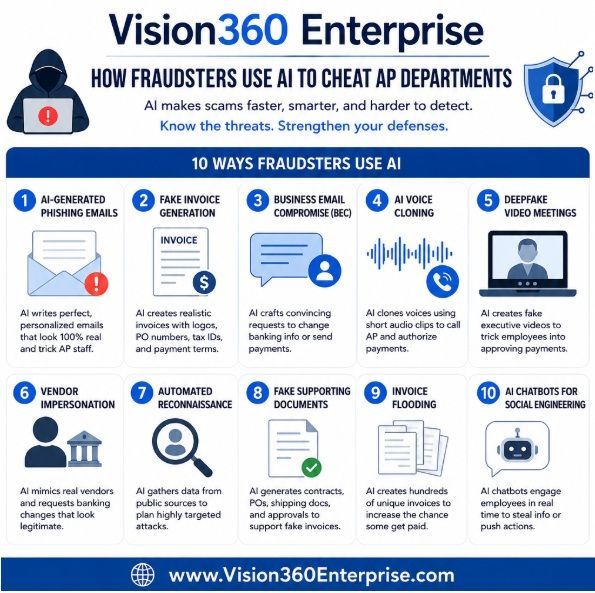
How Accounts Payable Automation Reduces the Potential Risk of Fraud and Security Attacks
Why AI Data Capture Is Replacing OCR in Accounts Payable
By Richard Pigott December 9, 2025
In today’s AP environment, the question isn’t whether AI is better than OCR—it’s whether organizations can afford to keep using OCR at all.
By Richard Pigott November 12, 2025
Executive Summary: Why ERP-Native AP Automation Fails — and Why Vision360 Enterprise Wins ERP “AP Automation” promises simplicity but delivers shallow workflow. Vision360 Enterprise was built from the ground up to automate the entire invoice lifecycle — from intelligent capture to payment — delivering true AI-powered efficiency, faster ROI, and freedom from ERP lock-in. 1. ERP Vendors Build Breadth, Not Depth ERP systems manage everything — but master nothing. Vision360 Enterprise focuses solely on AP automation , achieving: 2–3× higher straight-through processing Faster adoption and measurable time-to-value Continuous AI learning and enhancement 2. ERP “Automation” = Manual Workflows in Disguise ERP modules digitize invoices but still depend on manual validation, GL coding, and exception routing. Vision360 Enterprise applies automated business rules and logic to achieve near-touchless processing. 3. ERP Customization = Permanent Technical Debt ERP automation success requires heavy scripting and consulting — each upgrade breaks it again. Vision360 Enterprise integrates natively, updates seamlessly, and eliminates technical debt. 4. ERP Lock-In Limits Agility ERP automation binds you to one vendor and one process. Vision360 Enterprise connects across multiple ERPs, entities, and regions — providing agility through change. 5. Vision360 Enterprise Delivers Measurable ROI 70–80% fewer manual AP touches 50–60% faster invoice cycle times 2× early-payment discount capture Payback in under 12 months Conclusion: ERP vendors digitize invoices. Vision360 Enterprise automates intelligence. For finance leaders serious about eliminating manual work, improving visibility, and future-proofing their payables process — Vision360 Enterprise is the clear strategic choice.
By Richard Pigott October 31, 2025
Every month-end, accounting teams face the same challenge: closing the books quickly, accurately, and in compliance with reporting standards. But one recurring issue often slows things down — missing accruals. If you’ve ever been asked by accounting to “send your accruals,” it’s not just a formality. Your accruals are essential to producing an accurate picture of the company’s financial health. What Are Accruals? Accruals represent expenses that have been incurred but not yet invoiced or paid. They align costs to the correct accounting period — ensuring financial results accurately reflect when the work was done or the goods were received. Without accruals, one month’s profit may look inflated while the next month is overstated — skewing performance metrics, budgets, and forecasts. Why Accounting Needs Your Accruals 1. To Ensure Accurate Financial Reporting Accruals help accounting record expenses in the period they were incurred, not when invoices arrive. This ensures management and stakeholders see the company’s true financial position. 2. To Avoid Budget and Forecast Distortions When expenses are recognized late, they show up in the wrong month — confusing budget owners and making forecasts unreliable. Timely accruals keep budgets aligned and predictable. 3. To Accelerate the Month-End Close Every missing accrual adds hours or even days to the close process. Submitting accruals promptly helps accounting close faster, deliver timely reports, and support better business decisions. 4. To Maintain Compliance and Audit Readiness Auditors look for complete and consistent expense recognition. Well-documented accruals show adherence to GAAP or IFRS standards and demonstrate strong financial controls. 5. To Strengthen Collaboration Between Finance and Operations Submitting accurate accruals isn’t just helping accounting — it’s helping your entire business operate with transparency and precision. Best Practices for Submitting Accruals Track pending costs: Keep notes on goods or services received but not yet invoiced. Communicate early: Let accounting know about large or recurring expenses before month-end. Meet deadlines: Submit accrual details on time to support a smooth close process. Vision360 Enterprise: Using an AP Automation system like Vision360 Enterprise allows centralized processing of supplier invoices which allows accounts payable visibility and control with the ability to generate accruals instantaneously. The Bottom Line Accruals are more than a technical accounting task — they’re the foundation of financial accuracy. When every department participates in the accrual process, the result is faster closes, cleaner reports, and better business decisions. So next time accounting asks for your accruals, remember: they’re not chasing paperwork — they’re protecting accuracy, compliance, and the integrity of the numbers.
By Richard Pigott October 28, 2025
Be honest: Does your Accounts Payable process still rely on paper, email approvals, and manual data entry? If so, your AP process might be stuck in 1999 — while the rest of finance has moved decades ahead. In today’s fast-paced, AI-driven finance world, AP automation isn’t optional anymore — it’s essential. Here are five signs your Accounts Payable process needs automation, and how modern finance teams are transforming their workflows with AI-powered invoice processing and automated approval systems. 1. You’re Still Digging Through Emails or Paper Invoices If your team still receives invoices as PDFs, attachments, or even paper copies, you’re stuck in a pre-cloud era. Back in 1999, mail and fax were standard. But in 2025, manual invoice handling wastes time, increases data entry errors, and limits visibility. Modern AP automation systems use intelligent data capture, AI and OCR technology to automatically extract and validate invoice data — no typing, no spreadsheets, no missing files. Why it matters: Eliminates manual entry and human error Prevents lost or duplicate invoices Speeds up processing and approvals Modern alternative: A cloud-based invoice capture service that imports invoices automatically and syncs them directly with your ERP or accounting platform. 2. Approvals Still Depend on Email Threads or Paper Signatures If managers still approve invoices by replying to emails or signing paper copies, your invoice approval workflow hasn’t changed in 25 years. Today’s AP automation platforms use automated approval workflows that route invoices instantly based on predefined rules — by department, spend threshold, or GL code. Every action is tracked, timestamped, and auditable. Benefits of automation: Instant routing and escalation Full visibility for AP and management Clear audit trail and compliance record Modern alternative: Rules-based approval automation that eliminates delays, reduces bottlenecks, and ensures on-time payments. 3. You Have Little or No Real-Time Visibility Into Payables In 1999, waiting for end-of-month reports was normal. But in 2025, real-time visibility into payables is mission-critical for cash flow and forecasting. If you’re still updating spreadsheets or manually reconciling data, you’re missing the insights needed to manage spend effectively. Modern Accounts Payable automation dashboards show invoice statuses, exception alerts, and payment readiness in real time — no waiting, no guesswork. Why visibility matters: Prevents late payments and cash surprises Supports better decision-making Strengthens supplier relationships Modern alternative: A real-time AP analytics dashboard that delivers instant insight into outstanding invoices, payments, and workflow performance. 4. You’re Still Cutting Paper Checks or Logging Into Multiple Portals If your AP team still prints checks or logs into multiple banking portals to make payments, you’re wasting hours on tasks that modern payment automation systems can do in seconds. In 1999, that was standard. Today, automated payment processing securely matches invoices to purchase orders, schedules payments, and reconciles accounts automatically. Why automate payments? Reduces fees, errors, and fraud Improves supplier satisfaction Speeds up month-end close Modern alternative: End-to-end payment automation that manages ACH, virtual cards, and digital payments directly from your AP automation platform. 5. Your AP Team Is Overworked and Undervalued If your Accounts Payable team spends most of their time keying data, chasing approvals, and answering vendor questions, they’re working harder — not smarter. AI in Accounts Payable eliminates repetitive work, empowers staff, and shifts focus toward higher-value activities like supplier analysis and cash management. Benefits of AI-powered AP workflows: 70–80% fewer manual tasks Lower risk of data errors Happier, more productive teams Modern alternative: AI-driven AP automation software with intelligent routing, exception handling, and self-service supplier portals. The Bottom Line: 1999 Processes Can’t Compete in 2025 and Beyond. Finance has evolved. Paper-based, manual Accounts Payable processes haven’t. Modern AP automation solutions deliver speed, accuracy, and real-time visibility across the entire invoice-to-pay cycle. By embracing AI and automated workflows, you build a finance operation that’s smarter, faster, and future-proof. If your current AP workflow shows even one of these five signs, it’s time to automate — because 2025-ready finance teams don’t just process invoices, they analyze, optimize, and innovate. Next Steps: Modernize Your Accounts Payable with AI Audit your current AP workflow — find bottlenecks, delays, and data entry points. Calculate your manual processing cost — time, errors, and lost discounts add up. Explore AI-powered AP automation software that integrates with your ERP and provides full visibility. Don’t let your Accounts Payable team operate like it’s still 1999. Modernize with AI-driven AP automation to reduce costs, accelerate approvals, and empower your finance team. If you’re ready to see how AI-powered AP Automation can transform your finance operations, book a demo or schedule a workflow assessment . We’ll show you how to eliminate manual processes, reduce costs, and bring your Accounts Payable process into the modern era.