Is It Time to Replace Your Outdated Legacy AP Automation System with a Modern, Lower-Cost Alternative?
For years, Accounts Payable automation has promised greater efficiency, lower costs, and stronger controls. And for many organizations, early-generation AP automation systems delivered on that promise—at least for a while.
But what happens when the system that once modernized your AP function becomes the very thing holding it back?
For many finance teams, that’s the reality today.
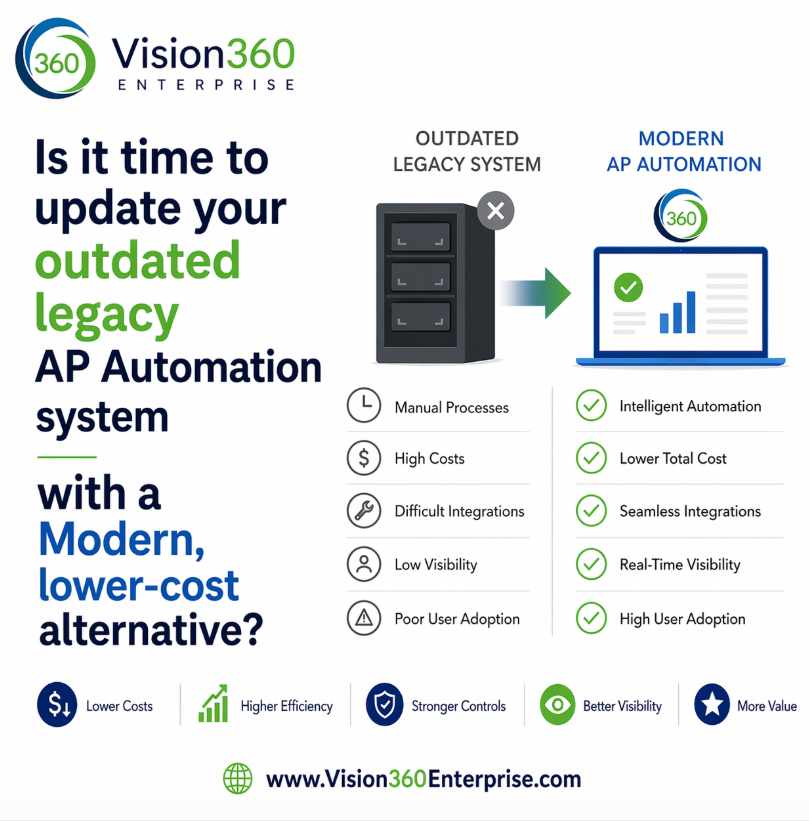
Legacy AP automation platforms—particularly those implemented five, ten, or even fifteen years ago—were built for a different era. They often rely on rigid workflows, expensive licensing models, outdated OCR technology, and costly services engagements just to make basic changes.
Meanwhile, newer AP automation platforms are leveraging AI, machine learning, cloud-native architectures, and subscription models that are often significantly less expensive to operate.
So the question becomes:
Is it time to replace your legacy AP automation system with a modern, lower-cost alternative?
For many organizations, the answer may be yes.
Signs Your Legacy AP Automation System Is Holding You Back
1. Your “Automation” Still Requires Too Much Manual Work
One of the clearest warning signs is when your AP team still spends excessive time correcting invoice data, routing exceptions, or chasing approvals despite having automation software.
Older systems often depend heavily on template-based OCR or rules-based extraction that struggle with supplier variability and exceptions. That means your team may still be doing the same work—just inside a different system.
Modern AI-powered invoice capture can dramatically reduce touchpoints by learning from data, improving over time, and handling more exceptions automatically.
If your automation still feels manual, it may no longer be automation.
2. Your Costs Keep Rising
Many legacy systems come with hidden or escalating costs:
- High annual maintenance fees
- Per-invoice transaction charges
- Expensive upgrade projects
- Consultant fees for workflow changes
- Additional charges for integrations or support
In some cases, organizations are paying enterprise-level costs for technology that no longer delivers enterprise-level value.
Modern SaaS AP platforms often offer:
- Lower subscription pricing
- Faster implementations
- Reduced support dependency
- Automatic updates included
- Lower total cost of ownership (TCO)
If you’re spending more each year just to maintain the status quo, it may be time to reevaluate.
3. Your System Wasn’t Built for AI
Artificial intelligence is rapidly transforming AP—from intelligent invoice capture and predictive coding to exception handling and fraud detection.
But many legacy systems were never designed to support these capabilities. Trying to bolt AI onto aging infrastructure can be expensive, limited, and underwhelming. Modern platforms, by contrast, are being built with AI at the core—not as an add-on.
That changes what’s possible.
4. Integrations Have Become a Burden
Your ERP has evolved. Your business applications have changed. Your automation platform… hasn’t.
Legacy systems often require custom integrations that are brittle, expensive to maintain, and difficult to update. If every ERP upgrade creates risk—or every new business process requires IT involvement—that’s a signal your technology may be aging out.
Modern systems typically offer API-first integrations, prebuilt connectors, and faster deployment models that reduce both complexity and cost.
5. User Adoption Is Poor
When approvers avoid the system, suppliers struggle with portals, or AP teams rely on workarounds outside the platform, it often points to usability issues.
And usability matters. A system no one likes to use rarely delivers full ROI.
Modern AP platforms prioritize user experience with:
- Intuitive approval workflows
- Mobile approvals
- Supplier-friendly onboarding
- Better dashboards and visibility
- Consumer-like interfaces finance users actually embrace
Technology should simplify work—not create friction.
The Cost of Keeping Legacy AP Automation
Many organizations delay replacing AP automation because the current system “still works.”
But that mindset can be expensive.
The real cost of legacy systems often includes:
Operational Inefficiency
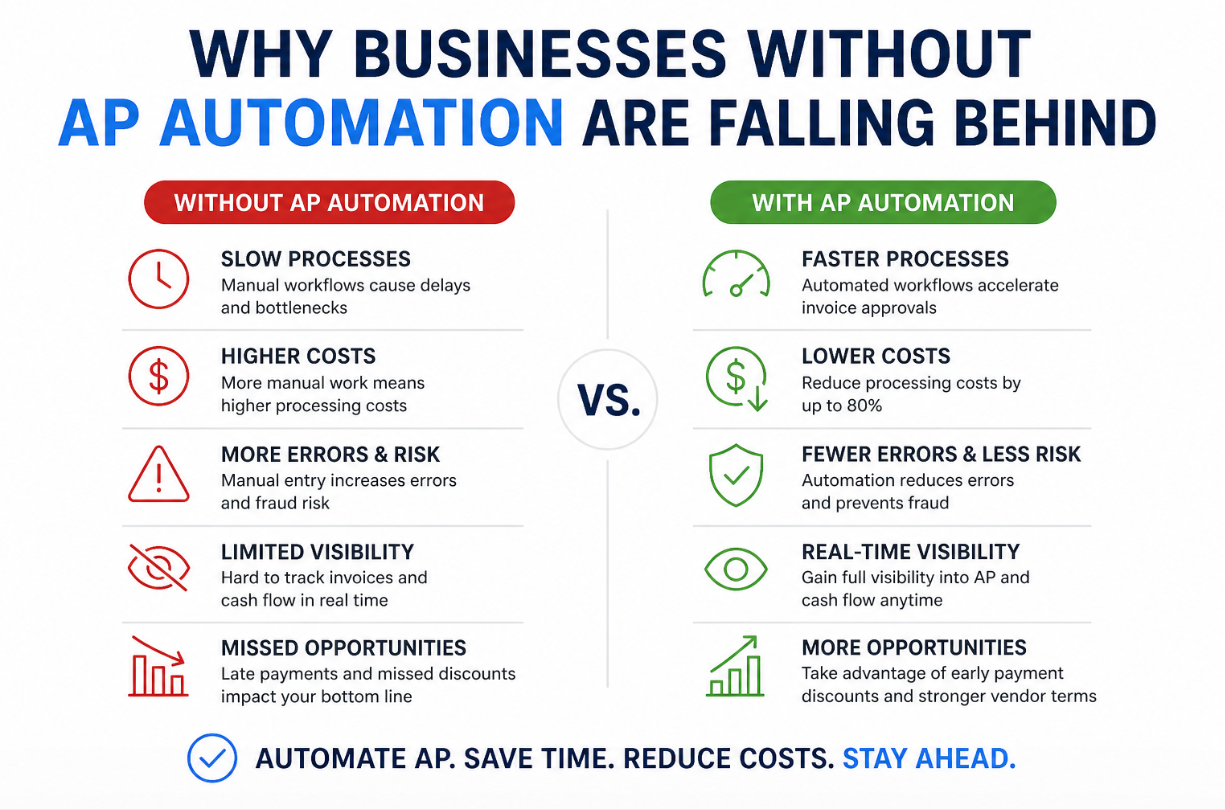
- Manual intervention increases invoice processing costs and slows cycle times.
Missed Discount Opportunities
- Slow approvals mean missed early payment discounts.
Higher Risk Exposure
- Older controls may leave gaps in fraud prevention, duplicate detection, or audit readiness.
Innovation Delay
- Legacy technology can prevent AP from supporting broader digital transformation goals.
Opportunity Cost
- Resources spent maintaining old systems could be invested in higher-value finance initiatives.
Sometimes the most expensive system is the one you’ve already paid for.
Why Companies Are Replacing Rather Than Upgrading
Increasingly, organizations are finding that replacing a legacy AP platform costs less—and delivers more value—than trying to modernize an outdated one.
Why?
Because “upgrades” often mean:
- Re-implementations disguised as upgrades
- Added modules at additional cost
- New consulting engagements
- Minimal improvements to underlying architecture
In many cases, a modern replacement can deliver faster time-to-value with less disruption than expected.
And with today’s cloud deployment models, switching platforms is far less daunting than it once was.
What to Look for in a Modern AP Automation Alternative
If you’re considering a change, focus on solutions that deliver value in five key areas:
1. AI-Driven Invoice Processing
- Look for intelligent capture and touchless processing—not just OCR.
2. Lower Total Cost of Ownership
- Evaluate licensing, support, implementation, and ongoing maintenance.
3. ERP Connectivity
- Ensure seamless integration with your existing ERP and future ecosystem.
4. Scalability
- Choose a platform that can grow with your business.
5. Ease of Use
- User adoption often determines success more than feature lists.
A Simple Test: Ask Yourself These Questions
If you answer “yes” to any or several of these questions, it may be time to explore alternatives:
- Are we overpaying for our current AP system?
- Does invoice processing still involve too much manual work?
- Are upgrades costly and disruptive?
- Is our system limiting AI adoption?
- Do integrations require too much IT support?
- Are users frustrated with the platform?
- Could a newer solution reduce costs and improve performance?
If these questions resonate, you may already have your answer.