Why It's Becoming Increasingly Difficult to Find and Hire Accounts Payable Specialists
Not long ago, replacing an Accounts Payable specialist was a relatively straightforward process. If someone retired or accepted another position, companies could typically expect to fill the vacancy within a few weeks. Today, that same search can take months, and even then, finding someone with the right combination of experience, technical knowledge, and attention to detail has become increasingly difficult.
Finance leaders across nearly every industry are feeling the impact.
While organizations continue to grow and invoice volumes steadily increase, the pool of experienced AP professionals appears to be shrinking. Many of the people who built their careers managing Accounts Payable over the past thirty years are reaching retirement, taking decades of knowledge with them. At the same time, fewer younger professionals are choosing Accounts Payable as a long-term career, often gravitating toward finance roles that offer greater exposure to analytics, technology, or strategic planning.
This shift couldn't come at a worse time.
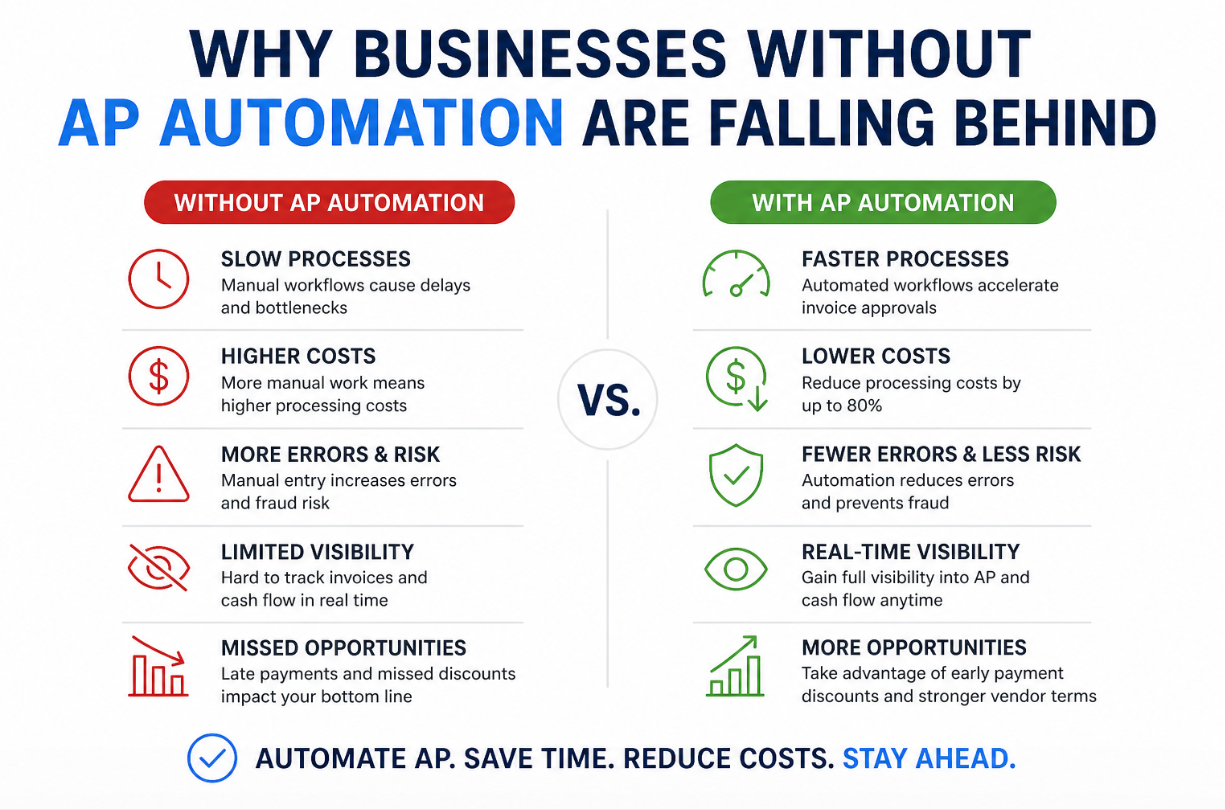
The responsibilities of today's AP departments extend far beyond entering invoice data into an ERP system. Finance teams are expected to manage electronic invoices from multiple sources, navigate increasingly complex approval workflows, identify duplicate invoices, prevent fraud, monitor cash flow, capture early payment discounts, and provide real-time visibility into outstanding liabilities. What was once viewed as an administrative function has quietly evolved into a critical component of financial operations.
Unfortunately, many organizations continue to staff Accounts Payable as though very little has changed.
When an experienced employee leaves, the remaining team often absorbs the additional workload while management searches for a replacement. Initially, the impact may seem manageable, but over time the consequences become more apparent. Vendor inquiries increase, invoice backlogs begin to develop, payment deadlines become more difficult to meet, and month-end close can take longer than expected. Just as concerning, the employees who remain are frequently asked to do more with fewer resources, increasing the risk of burnout and turnover.
The instinctive response is often to recruit more people, offer higher salaries, or rely on temporary staffing. While these strategies may help in the short term, they do little to address the larger workforce trend. Demand for experienced AP professionals continues to outpace supply, and there is little indication that the labor market will suddenly reverse course. Simply hiring more people is becoming a more expensive and less reliable strategy every year.
Instead, many finance leaders are beginning to ask a different question. Rather than focusing solely on how to replace the employee who left, they are asking how their existing team can accomplish more without adding headcount. That shift in thinking is changing the way organizations view Accounts Payable.
AI-assisted automation is no longer just about reducing paper or eliminating manual data entry. It has become a practical response to one of the finance department's most pressing challenges: maximizing the productivity of experienced employees whose time has become increasingly valuable. When repetitive tasks such as invoice capture, data validation, routing approvals, and matching purchase orders are automated, AP professionals are free to concentrate on the work that truly requires human expertise. They spend less time entering information and more time resolving exceptions, strengthening vendor relationships, and improving financial performance.
Perhaps the most significant benefit isn't that automation replaces people—it doesn't. It helps organizations become less dependent on continually hiring additional staff to keep pace with growth. An AP department supported by intelligent automation can process substantially more invoices with the same team, adapt more easily to employee turnover, and maintain consistent performance even when hiring proves difficult.
The companies that will be most successful over the next decade may not be those with the largest finance departments or the biggest recruiting budgets. More likely, they will be the organizations that recognize technology as a force multiplier—one that enables experienced employees to contribute at a higher level instead of spending their days on repetitive administrative work.
Finding great Accounts Payable professionals will probably never become easy again. But building an AP department that depends less on constantly finding them may prove to be one of the smartest investments a finance leader can make.