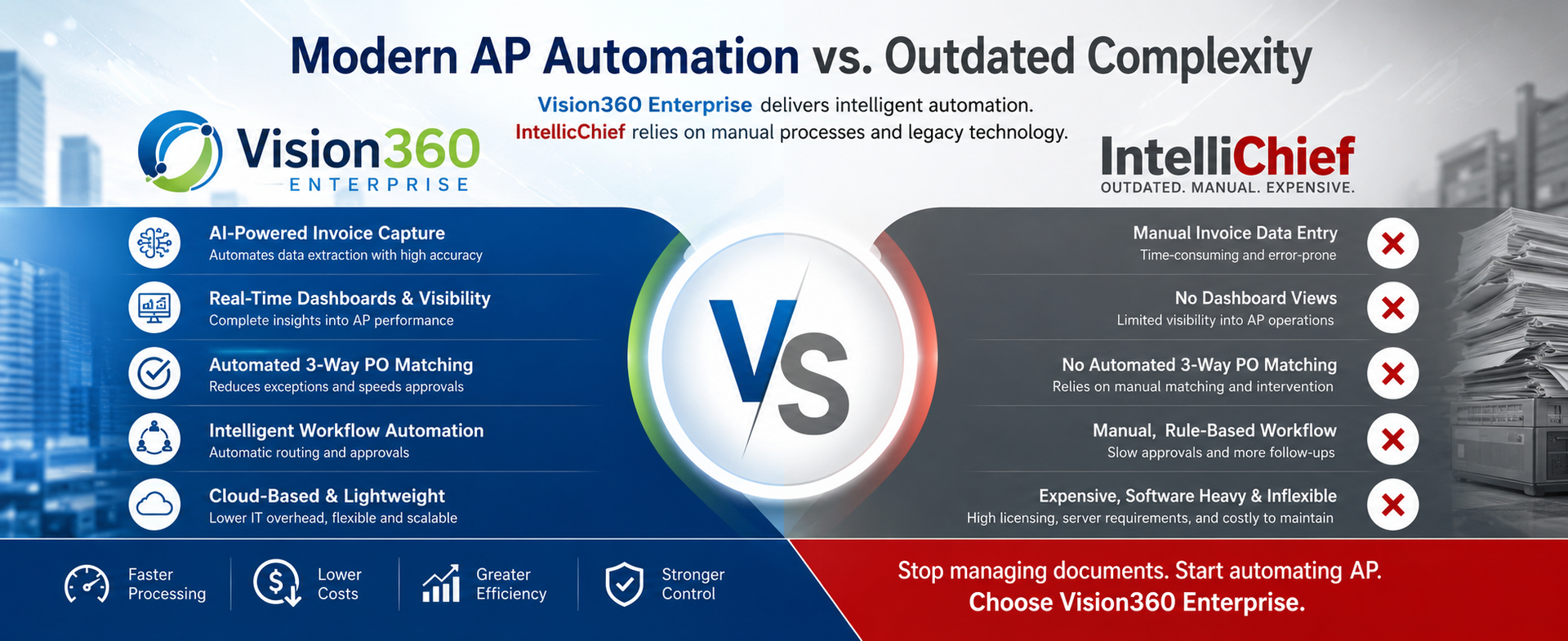
Vision360 Enterprise vs. IntelliChief
When evaluating modern Accounts Payable automation platforms, the differences between legacy document management systems and true AI-driven automation solutions become very clear. While Intellichief has historically been positioned as a document management and workflow platform, many organizations are finding that it still relies heavily on manual intervention, traditional workflows, and infrastructure-heavy deployments. In contrast, Vision360 Enterprise is designed as a modern, intelligent AP Automation platform focused on minimizing manual effort, improving visibility, and accelerating invoice processing.
| Feature | Vision360 Enterprise | Intellichief |
|---|---|---|
| Invoice Data Capture | AI-driven automated invoice extraction with minimal human intervention | Relies heavily on OCR and validation workflows that often require manual review and data correction |
| Workflow Automation | Intelligent automated routing and approvals | Primarily rules-based manual workflow routing |
| Dashboard Visibility | Real-time dashboards, analytics, and AP status visibility | Limited operational dashboards and visibility capabilities |
| 3-Way PO Matching | Automated 2-way and 3-way PO matching with exception handling | More dependent on configuration and manual validation |
| User Experience | Modern cloud-based interface designed for AP efficiency | Traditional ECM/document management style interface and relies heavily on manual intervention |
| Infrastructure Requirements | Lightweight cloud deployment with reduced IT overhead | Requires extensive IT resources, software-heavy with server, licensing, and infrastructure requirements |
| Scalability | Flexible and adaptable to changing business processes | Less flexible and often more difficult to modify |
| Core Focus | End-to-end AP Automation | Document storage and workflow-centric ECM platform |
| Processing Efficiency | Designed for touchless invoice processing | Requires significant manual interaction |
| Cost Structure | Lower total cost of ownership with reduced IT maintenance | Higher licensing, infrastructure, and maintenance costs |
Why Many Organizations Are Moving Away from Legacy AP Systems
Older AP automation platforms were originally designed around document storage and basic workflow routing. While these systems improved paper handling, they often did not fully eliminate manual AP work. Many companies still find themselves:
- Manually keying invoice data
- Correcting OCR extraction errors
- Chasing approvals through workflow queues
- Managing exception handling manually
- Maintaining expensive on-premise infrastructure
- Paying for additional user licenses and server resources
Industry discussions around AP automation continue to highlight frustrations with manual invoice handling, OCR limitations, and disconnected approval workflows.
Where Vision360 Enterprise Stands Apart
Vision360 Enterprise focuses on true automation rather than simply digitizing paper processes. The platform is built to reduce AP staff workload while providing finance teams with complete visibility into invoice processing activity.
Key advantages include:
- AI-powered invoice data extraction
- Automated workflow approvals
- Real-time AP dashboards
- Automated PO matching
- Reduced manual touchpoints
- Faster invoice cycle times
- Cloud-based deployment
- Lower IT dependency
- Greater flexibility for changing business needs
Modern AP automation trends increasingly emphasize intelligent extraction, automated validation, exception management, and touchless processing rather than legacy OCR and document storage approaches.
The Bottom Line
For organizations looking to modernize Accounts Payable operations, the difference comes down to whether the goal is simply storing documents electronically or fully automating the AP process.
Vision360 Enterprise delivers a modern AP automation platform designed to reduce manual effort, improve financial visibility, automate invoice processing, and lower operational costs.
Intellichief, while capable as a document management and workflow platform, still reflects many characteristics of older-generation ECM technology that can require more manual intervention, greater IT involvement, and higher long-term ownership costs.
